Psychological Pressure in Penalty Shootouts: Case Studies from Football
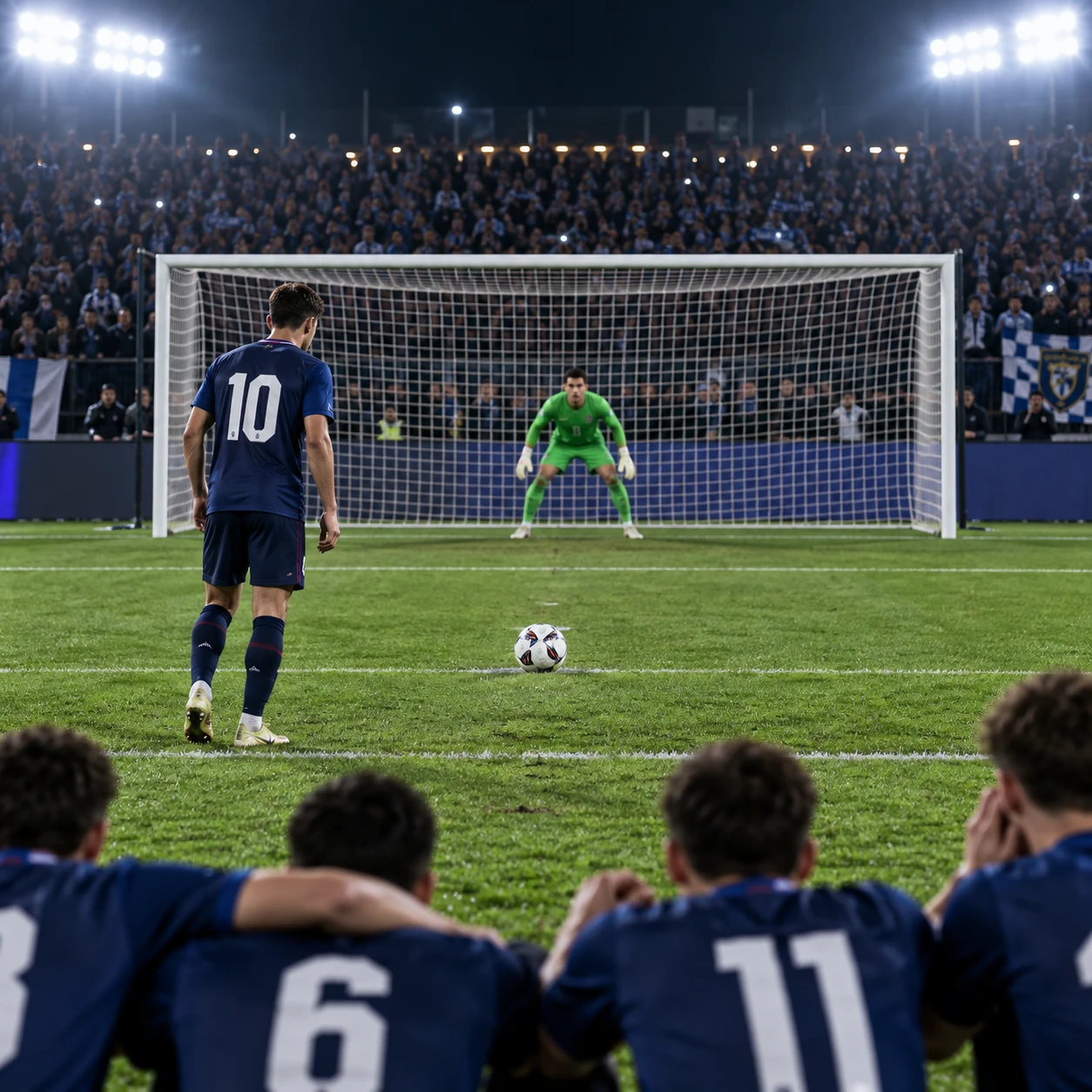
A penalty shootout reduces a team sport to a sequence of one-on-one decisions. The penalty taker has a ball, a target and a brief moment to act; the goalkeeper has little time to respond. Yet the result is shaped by more than technique. Anxiety, focus, confidence, team pressure and match context all influence what players do, while skill and chance remain part of the story.
Why penalty shootouts create intense pressure
Penalty shootouts create intense pressure because each kick can affect a match’s outcome, and the player performs alone in front of a watching crowd. The format makes responsibility unusually visible: there is no teammate nearby to share the immediate decision.
Context changes how a kick feels. A spot kick in an early round of a tournament may carry less immediate consequence than one that could decide a final. The score in the shootout, the order of kicks, fatigue after extra time and the reaction of teammates can all weigh on a player. So can the memory of an earlier miss, though an observer cannot reliably infer what a player is feeling from a single gesture.
The goalkeeper faces a different version of the same spotlight. They must wait, read limited clues and commit to a direction, often with little chance to correct the choice. A save can turn into a defining moment; a goal may be treated as expected. That imbalance can affect perceived pressure, even though both roles involve uncertainty and consequences.
It is tempting to call a shootout a purely mental test. That misses the fundamentals: a well-struck, accurately placed shot can beat a goalkeeper who guesses correctly, while a keeper’s reach, positioning and reaction matter alongside anticipation. Psychology helps explain decisions and execution; it does not explain every outcome.
What happens mentally before a penalty
Before a penalty, the player must manage anxiety, direct attention and commit to a decision. A clear plan can steady the process, but pressure may make it harder to follow that plan consistently.
For the penalty taker, attention can become a contest between the intended action and distracting thoughts: the goalkeeper’s movement, the crowd, the score or the cost of missing. Too much attention to the consequences may disrupt a familiar kicking motion. On the other hand, a player who is overconfident or rushing can neglect useful details such as approach speed and body balance.
Decision-making usually involves choosing a target and deciding whether to stick with it or react to the goalkeeper. Each option has a trade-off. Committing early can support a decisive strike but allows the goalkeeper to anticipate; waiting for a cue may provide information but risks hesitation or a less controlled shot.
A pre-shot routine gives the taker a repeatable sequence, such as placing the ball, stepping back, taking a breath and focusing on a chosen target. The point is not to erase anxiety. It is to bring attention back to controllable actions. A routine can also become a distraction if a player treats it as a guarantee or changes it under pressure without practice.
Goalkeepers also manage attention. They may study a taker’s approach, look for patterns or use movement to influence the shot. But visible cues are imperfect; the same run-up can lead to different targets. Patience matters because diving too early can turn a possible save into an empty goal.
Case studies: pressure on the penalty taker
Case studies show how penalty takers combine technique with decisions under pressure, but a result alone cannot prove what a player felt. The context and visible execution offer more reliable evidence than speculation about private thoughts.
Roberto Baggio, 1994 World Cup final
In the 1994 FIFA World Cup final against Brazil, Italy’s Roberto Baggio sent the decisive kick over the crossbar, giving Brazil the title. The miss became one of football’s most enduring images because of the stakes and the finality of the shootout. It does not, by itself, establish that anxiety caused the error. Fatigue, the mechanics of the strike and the narrow margin between a goal and a miss are relevant considerations too.
The episode illustrates how match context shapes the meaning of a kick. A similar miss in a routine league match would not carry the same historical weight. Retrospective accounts can also make a single moment seem like an inevitable psychological collapse, even though the outcome depended on one attempt.
England at Euro 2020
In the Euro 2020 final, England lost the shootout to Italy after Marcus Rashford, Jadon Sancho and Bukayo Saka missed their attempts. The three players were young, and the order and circumstances drew intense public attention. Those facts are part of the context; they do not give outsiders a basis to diagnose any player’s mental state.
For a team, selection and order can become part of the pressure. A taker may carry the expectations of teammates, supporters and a national audience, while also trying to execute a familiar skill. The case is a reminder to separate an observable result from an assumption: a missed penalty shows that the shot did not score, not exactly why.
Across both examples, a useful way to assess a taker is to ask three questions: What was at stake? What choice did the player make? What can be observed about the execution? That keeps analysis grounded without ignoring the human pressure surrounding the kick.
Case studies: the goalkeeper’s psychological battle
Goalkeepers face a psychological battle of anticipation, patience and uncertainty: they must choose when to act without knowing where the ball will go. A successful save may reflect a good read, sound positioning, execution or some combination of all three.
Emiliano Martínez in the 2022 World Cup final
Argentina goalkeeper Emiliano Martínez played a visible role in the 2022 FIFA World Cup final shootout against France. He saved Kingsley Coman’s attempt, while Aurélien Tchouaméni sent his kick wide; Argentina then converted enough of its own penalties to win. Martínez’s presence and activity drew attention, but the outcome cannot be attributed to goalkeeper psychology alone. The takers’ decisions and execution, along with the team’s successful kicks, also mattered.
Martínez’s performance highlights how a goalkeeper can try to shape the moment through positioning, movement and confidence. Such tactics may unsettle a taker or encourage a rushed choice, but they are not reliable controls. A composed player with a well-placed shot can still score, and a keeper who commits to the wrong side cannot recover.
For goalkeepers, there is also a practical asymmetry: a taker can score by sending the ball beyond reach, whereas the keeper needs to predict and reach the chosen area. That makes patience and reading useful, but guessing remains part of the job. Anticipation is a probability, not certainty.
Preparation, routines, and pressure management
Preparation helps players manage penalty pressure by making decisions and actions more familiar before the shootout begins. It can improve readiness, but no routine or rehearsal guarantees a goal or a save.
- Practise under varied conditions: Rehearse penalties after demanding sessions, with noise and waiting periods, rather than only taking relaxed shots in training. This adds useful pressure cues, though practice cannot fully reproduce a major final.
- Set a clear plan: Takers can choose a primary target and a simple alternative if circumstances change. Goalkeepers can review opponents’ tendencies while treating them as clues, not rules.
- Keep the routine brief: A consistent sequence of actions helps focus attention on the next task. Players should rehearse it often enough that it remains familiar when tired.
- Agree team roles in advance: Coaches and players can discuss the order and who is willing to take a kick. Clarity reduces last-minute confusion, but the plan may need adjustment for substitutions, injury or match conditions.
Teams should avoid treating data or scouting as a script. A goalkeeper may know a taker’s preferred side, but players can adapt, and a small sample can mislead. The practical aim is to prepare options, then make a calm decision in the moment.
What these shootouts reveal about mental resilience
Penalty shootouts reveal that mental resilience means returning attention to the next controllable action, not being free of nerves. Results still depend on technique, decision-making, the goalkeeper’s response and the circumstances of the match.
For takers, that action might be sticking to a chosen target and completing the run-up. For goalkeepers, it may mean staying balanced until the shot offers enough information to act. Teams can support both roles with clear preparation and measured reactions, rather than making one player responsible for an entire result.
The fairest reading of a shootout holds two ideas together: psychological pressure is real, and it is difficult to measure from the outside. A miss or save is one visible outcome of a high-stakes contest, not a complete explanation of the person who took part.
Frequently asked questions
Why are penalty shootouts so psychologically demanding?
A shootout puts individual decisions under public scrutiny, often after a long match, and each kick can change the result. The taker and goalkeeper must act under uncertainty while managing the consequences attached to the moment.
Do penalty takers or goalkeepers face more pressure?
Neither role is universally more pressured. Takers carry direct responsibility for scoring, while goalkeepers must anticipate a shot with limited time and may be judged against an expectation that they should save it.
Can a pre-shot routine help under pressure?
Yes. A familiar routine can direct attention toward controllable steps and support consistency. It cannot remove anxiety or ensure that a shot will score.
Does taking the first penalty offer a psychological advantage?
Taking the first kick may help a team set the tone, but it does not guarantee an advantage. The shootout’s score, the players involved and the match context all affect how each attempt unfolds.