The Evolution of Football Tactics: From Catenaccio to Gegenpressing
Football has never stood still. From the locked defensive lines of 1950s Italy to the frantic pressing storms of Anfield and Signal Iduna Park, the game's tactical landscape has shifted dramatically — sometimes gradually, sometimes overnight. Understanding that evolution doesn't just satisfy historical curiosity. It changes how you watch the game, how you read a match, and why certain teams dominate their era while others scramble to catch up.
What Are Football Tactics and Why Do They Evolve?
Football tactics are the organized systems teams use to control space, create chances, and prevent goals — and they evolve because the game itself never stops changing. Rule modifications, advances in sports science, shifting player profiles, and the constant arms race between coaches all push tactical thinking forward.
When one system dominates, opponents study it and find the cracks. A new approach emerges to exploit those cracks. That new approach becomes dominant, and the cycle repeats. It's less a linear progression toward some "perfect" system and more a series of reactions — tactical evolution driven by necessity as much as innovation.
Physical conditioning also plays a role. Players in the 1990s simply couldn't sustain the pressing intensities that modern squads manage routinely. Better nutrition, recovery protocols, and positional coaching have expanded what's physically possible on a pitch. The tactics followed the athletes.
Catenaccio — The Art of the Lock
Catenaccio is an Italian defensive system built around compactness, positional discipline, and a specialized covering role known as the libero or sweeper. Translating roughly to "door bolt" in Italian, the philosophy prioritized defensive security above almost everything else.
The system gained prominence in Italian football during the 1950s and 1960s, most famously through Helenio Herrera's Inter Milan — the Grande Inter side that won back-to-back European Cups in 1964 and 1965. The libero sat behind the defensive line, free to read the game and intercept danger before it materialized. It was chess played at pace, with the board tilted heavily toward defense.
Critics called it cynical. Supporters called it intelligent. Both were right. Catenaccio produced results, but it also produced low-scoring, attritional football that frustrated neutrals. Its deeper legacy, though, is structural: it established that tactical organization could neutralize individual brilliance — a lesson every subsequent generation of coaches absorbed.
Total Football — Fluidity and the Dutch Revolution
Total Football dismantled the idea that players were locked to fixed positions. Developed at Ajax Amsterdam under Rinus Michels and embodied by Johan Cruyff, the philosophy demanded that any outfield player could occupy any role on the pitch — provided teammates rotated to fill the space left behind.
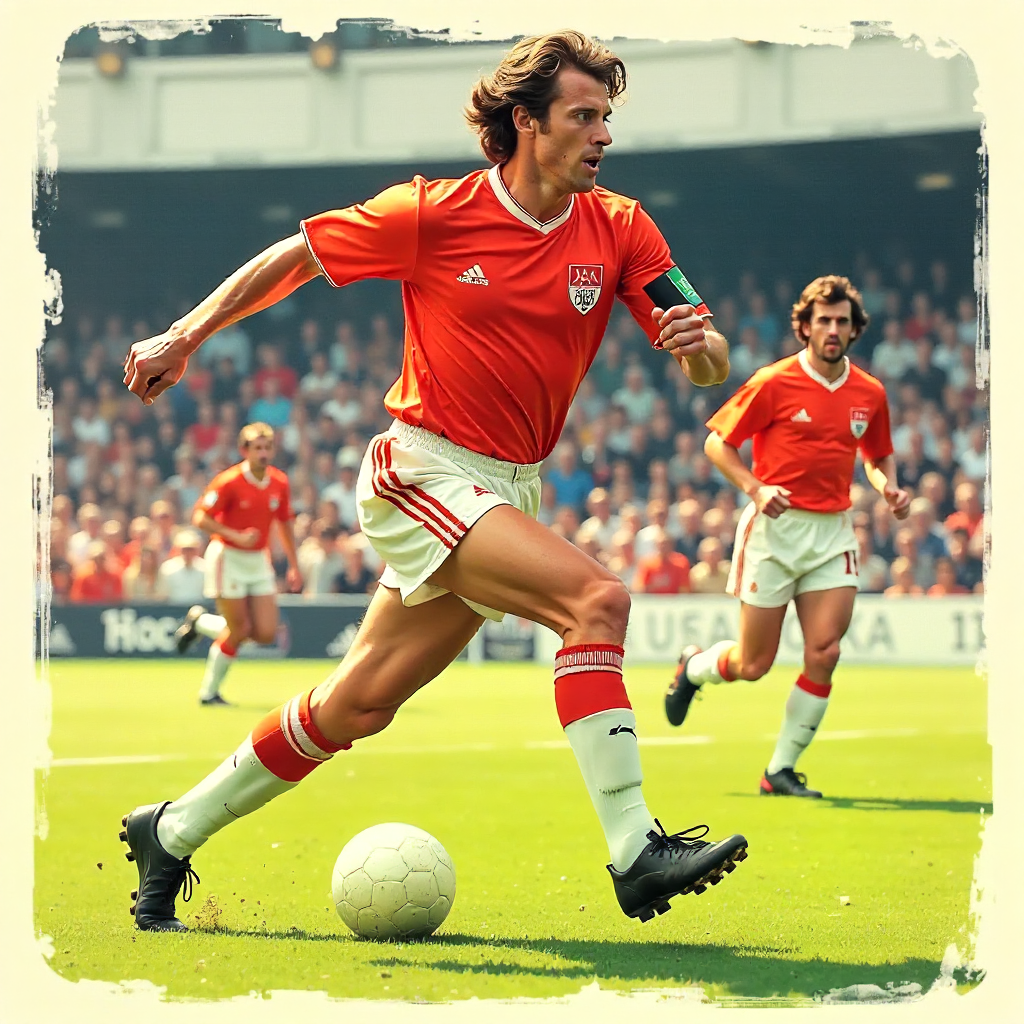
The Ajax side of the early 1970s and the Dutch national team at the 1974 World Cup became the movement's defining expressions. The Netherlands reached the final playing football that looked almost improvisational but was underpinned by rigorous spatial awareness and technical quality. Cruyff himself was the system's most visible intelligence — a forward who dropped deep, a playmaker who pressed high, a player who seemed to exist outside traditional positional logic.
Total Football's influence stretched far beyond its era. Cruyff later took the philosophy to Barcelona as a manager, planting seeds that would eventually grow into something the football world hadn't seen before. The connection between Ajax in 1972 and Guardiola's Barcelona in 2009 is direct, generational, and unmistakable.
The Rise and Reign of the 4-4-2
The flat 4-4-2 became the dominant global formation through the 1980s and 1990s because it balanced defensive solidity with attacking width in a way that suited the era's physical, direct style of play. Two banks of four provided structure; two forwards gave teams a constant aerial and pressing threat.
English football embraced it most completely. The Premier League's early years were defined by the 4-4-2 — high-energy, high-tempo, built on work rate and wide midfielders who could defend and attack. Clubs from Manchester to Milan used variations of the system because it was teachable, repeatable, and effective against most opponents.
What eventually undermined the flat 4-4-2 was the emergence of the number ten operating in the space between the opposition's midfield four and defensive four. Once coaches identified that gap as exploitable, the system's clean symmetry became a liability. A single creative midfielder could drag one of the four central players out of position, and the whole structure would shift uncomfortably. The search for solutions pointed toward more flexible midfield shapes — and that search accelerated tactical thinking considerably.
Tiki-Taka and the Possession Obsession
Tiki-Taka is a possession-based model that uses short, rapid passing combinations to control territory, tire opponents, and create openings through movement rather than direct penetration. Pep Guardiola's Barcelona side between 2008 and 2012 refined it into the most dominant club system of its generation.
The Spain national team ran a parallel track, winning Euro 2008, the 2010 World Cup, and Euro 2012 using essentially the same principles. At its peak, the system felt unbeatable — opponents couldn't win the ball back, couldn't establish rhythm, and often couldn't even touch the ball long enough to threaten.
But Tiki-Taka carried a structural vulnerability. It depended on technically elite players maintaining concentration and positioning for long periods. When opponents dropped into deep, compact defensive blocks and accepted that they'd see less of the ball, the system sometimes struggled to convert possession into goals. Bayern Munich's 7-0 aggregate demolition of Barcelona in the 2013 Champions League semi-finals exposed that limitation brutally — and it signaled that a new approach was coming.
Gegenpressing — Chaos as a Weapon
Gegenpressing is a high-intensity counter-pressing system that targets the moment immediately after losing possession, when the opposition is disorganized and the ball is most easily recovered. Jürgen Klopp developed and popularized the approach at Borussia Dortmund and then at Liverpool, where it became one of the most recognizable tactical identities in world football.
The core insight is simple but demanding: the five seconds after losing the ball are the best opportunity to win it back, because the team that just gained possession hasn't yet organized to protect it. By pressing immediately and aggressively in those seconds, a team can force turnovers in dangerous areas and launch attacks before the defense resets.
Klopp described it memorably as "the best playmaker in the world" — better than any individual passing sequence. The philosophy requires extraordinary fitness, collective discipline, and trust. Every player has to press simultaneously; one hesitant runner breaks the trap. At Liverpool between 2016 and 2020, the system reached its competitive peak — winning the Champions League, the Premier League, and reshaping how coaches across Europe thought about defending without the ball.
Where Tiki-Taka sought to suffocate opponents through control, Gegenpressing sought to overwhelm them through intensity. Both were responses to the same problem — how do you prevent the opposition from playing? — but they answered it from opposite directions.
What Comes Next? Modern Tactical Hybrids
Today's elite teams don't belong to a single tactical era — they borrow from all of them. The most sophisticated sides in modern football blend Gegenpressing's intensity with Tiki-Taka's positional structure, add defensive compactness drawn from Catenaccio's principles, and wrap it in the positional fluidity that Total Football introduced fifty years ago.
Guardiola's Manchester City is perhaps the clearest example: a team that presses high when the moment demands it, recycles possession patiently when it doesn't, and shifts between attacking and defensive shapes within a single phase of play. The rigid formation labels — 4-3-3, 4-2-3-1 — barely capture what's happening. These are fluid systems, not fixed diagrams.
The coaches driving this era don't dismiss history. They study it. Arrigo Sacchi's AC Milan in the late 1980s — with its high defensive line, coordinated pressing, and refusal to engage in man-marking — sits in the DNA of both Guardiola and Klopp's work, even if neither would describe themselves as Sacchi disciples. Ideas compound across generations in football just as they do in any other discipline.
What this means practically is that tactical literacy has become a genuine competitive advantage — for coaches, analysts, and increasingly for players who can read multiple systems and adapt in real time. The game rewards intelligence alongside athleticism now more than at any previous point in its history.
Frequently Asked Questions
What is the difference between Catenaccio and modern low-block defending?
Catenaccio used a libero as a free covering defender behind a zonal line, with the whole system built around disciplined positional structure. Modern low-block defending typically involves a compact 4-4-2 or 4-5-1 shape that defends in the team's own half but doesn't rely on a sweeper role. The intent is similar — limit space and deny goals — but the positional architecture is different.
Who invented Gegenpressing?
Gegenpressing as a named philosophy is most closely associated with Jürgen Klopp, who developed it systematically at Borussia Dortmund from 2008 onward. However, the concept of pressing immediately after losing possession has roots in earlier work, including Arrigo Sacchi's AC Milan and the pressing ideas explored in German football during the 2000s.
Is Tiki-Taka still used in modern football?
Pure Tiki-Taka — possession for its own sake — has largely given way to more purpose-driven positional play. Guardiola himself moved away from the Barcelona model, integrating more vertical passing and pressing into his systems at Bayern and City. Elements of Tiki-Taka survive in how teams use ball retention to manage game states, but the obsessive short-passing philosophy of 2008-2012 isn't dominant at the top level anymore.
How did Total Football influence Pep Guardiola's style?
Guardiola played under Johan Cruyff at Barcelona in the early 1990s, absorbing the positional principles of Total Football directly. Cruyff's emphasis on spatial awareness, pressing triggers, and positional interchangeability became foundational to how Guardiola thinks about the game. The line from Ajax 1972 to Barcelona 2009 runs through Cruyff as both player and coach.
Which tactical system is considered the most effective in football history?
No single system holds that title — effectiveness depends entirely on the players available, the era, and the opposition. Tiki-Taka dominated a decade; Gegenpressing reshaped the 2010s; Catenaccio won European Cups. Each system was optimal for its context. The more useful question is which principles from each era remain relevant today — and the answer is: most of them, in some form.